
SongRest: Music for Chronic Pain
Music
Music is the universal language of people, and it also seems to be the universal language of the brain. Vibrations are intrinsic to all life, and we are showing that vibrations of music can work with those of the brain to bring about repair and healing.
Brain
The human brain is an organ of awesome power and possibility, as well as great suffering. Our mission is to continue to study it in relation to pain and music, and to discover new methods of healing from pain.
Pain
Chronic pain is a public health issue for one-quarter of the population, and interferes seriously with the quality of life. We are addressing it it using music in new ways to align the brain's activity with healthy rhythms.
SongRest
SongRest was inspired by experience, knowledge of music, and new science. Our advisory board of musicians, technologists and health care professionals strive to make a difference in the lives of those suffering chronic pain.
Every note of music ever made came through the human brain. Every number was perceived and defined in the human brain; every mathematical formula was created, and every inspiration we have and will have arises from our brain.
About SongRest's Founder, Richard Merrill

SongRest was founded by Richard Merrill to investigate musical options for relief of chronic pain. Merrill has been living with chronic back pain for over 15 years, and is highly motivated to find solutions. He is a songwriter, musician, and artist with an engineering background.
While living with chronic pain, work at the software development company he co-founded, even working from home, became more and more difficult. Merrill looked for solutions for himself, and after finding some temporary relief with music, he began researching how music interacts with the brain, and in particular with the pain processing areas.
Subsequently, Merrill designed and led a research project with specially-formatted music to target the descending pain modulatory system, a brain system that can become distorted if the pain continues, resulting in "chronification" of the pain.
Merrill is excited about the possibility of collaborating with other scientists or institutions to expand the scope of this research, which by any measure shows distinct promise.
Email Richard Merrill: music@songrest.com
SongRest Paper Published in Peer-Reviewed Journal in 2021
The paper on SongRest's research project Rhythmically Enhanced Music as Analgesic for Chronic Pain, presented in 2020 (see below), was published in Biology and Life Sciences Forum, Issue ECB2021.
The paper was written by SongRest lead researcher Richard Merrill. Data was analyzed and reported by study co-author Mariam Taher Amin, of the Faculty of Medicine of Assiut University, Assiut, Egypt, in 2020.
In addition, we provided the anonymized data file from the study for download from Open Science Foundation and on ResearchGate, which will help other researchers in verifying data for research of this type.
Our research into Rhythmically Enhanced Music as Analgesic for Chronic Pain has received a great deal of attention, receiving many recommendations and being read over 800 times on the science website ResearchGate (Richard Merrill's Profile there).
View and download the paper: Rhythmically Enhanced Music as Analgesic for Chronic Pain
Summary of Music for Chronic Pain Presented at International Biomedicine Conference
SongRest recruited 11 volunteers, ranging in age from 33 to 78, to participate in a three-month study of music listening of an hour a day. Volunteers had all suffered from chronic pain of different etiologies for more than 1 year, including chronic back pain, rheumatoid arthritis, and chronic musculoskeletal pain due to a variety of causes. The study was completed in December 2019.
Each volunteer listened to music with embedded brainwave beats coinciding with the beats of healthy pain processing areas. The frequency shared by areas of the descending pain modulatory system is 7Hz.
Since brainwave frequencies are not precise integers, we matched musical key and tempo to the value closest to 7Hz. These values ranged from 6.5Hz to 7.6Hz, in order to match the key of the music.
We provided what are called "isochronic" beats, namely the same beat or tone provided to both ears. Our isochronic beats consisted of a musical tone matching the key of the music, which pulsed in volume louder/softer at a frequency of 6-7Hz. This provided a tone that was not distracting, but where the beats could clearly be heard.
In addition, the human brain is adept at recognizing harmonics of root tones, but 7Hz is too low to perceive as a tone, so we also selected multiples (octaves) of 7Hz that matched the key of the music. For instance, the lowest A on the piano is 28Hz. Where music was in the key of A, we used an embedded frequency channel of 4 x 7Hz = 28Hz.
Listening took place in two half-hour sessions each day. Each selection was a half-hour duration, so listening to one selection completed the requirement. Volunteers used the app on a computer or mobile device, for a listening period of 8 weeks, at which time the music was stopped. There was an additional 4 weeks as a non-music control at the conclusion.
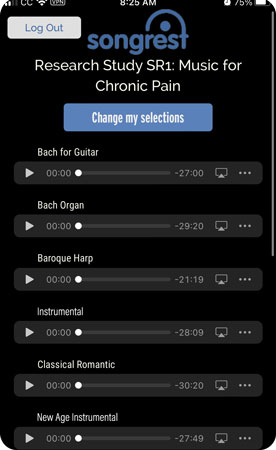
The app was unique in music research, in that it timed listening times to the second, so we knew how much listening each participant was doing, to match with their reported listening times. This provided hard evidence where other research normally uses self-reported listening times.
Pain self-assessments, using both a visual scale and a numerical pain score, were taken at the beginning of the study, and at two-week intervals thereafter. At two weeks and four weeks after the listening period ended, we took pain assessments to determine duration of any pain relief after the listening period. 4 people reported return of pain, with the remainder showing continued pain relief at 4 weeks after cessation of listening to the music.
To collect data, we created an app for desktop and mobile devices (shown at left) in which volunteers could log in to select as many pieces as they wished from a menu of music titles with 20-second samples of each piece to make it convenient to select their favorites.
The volunteers' musical selections were saved to our secure database, and when the listening period began, the selections were dynamically served to volunteers through the app as streaming files. Volunteers could choose different music at any time, and the new choices were immediately available to them.
Data was collected and collated by SongRest lead reasearcher Richard Merrill during and after the study. An anonymized data file containing volunteer age, pain med dose taken, pain scores, and listening times/durations was created.
Data was analyzed by study co-author Mariam Taher Amin, of the Faculty of Medicine of Assiut University, Assiut, Egypt, in 2020.
The significant results were:
- reduction in pain scores averaging 26%.
- reduction in medication doses averaging over 60% over all volunteers throughout the study.
- continued reduction in reported pain at 4 weeks after the cessation of listening.
The results are significant in three areas.
One, reduction in reported pain (pain scrores) is greater than or equal to pain reductions considered significant in meta-analyses of pain studies.
Two, reduction in pain medication doses of all kinds, including NSAID, opioid and RA medications, is highly significant.